Engineering
A collection of my engineering projects and experiences, from university work and internships to things I've designed and built myself.
I'm in the final year of an integrated MEng in Mechanical Engineering at the University of Sheffield, having spent my third year at the University of Waterloo in Canada. I particularly enjoy the whole design process: coming up with an idea, working through the engineering, making it, and finding out whether it actually works.
This page goes into a bit more detail than my CV, including the challenges along the way and what I learned from them.
Projects and experience
Select a project to jump to it.
Autogyro — MEng Project
Project overview
For my final-year MEng project, I'm working with Autogyro on fitting an internationally certified float system to a gyrocopter for amphibious operations. It's an interesting challenge because a float system certified in one context cannot be assumed to meet the requirements for another aircraft or country.
My work
I'm currently comparing international airworthiness and certification standards, identifying differences and looking at which requirements are most demanding. I'm then considering what tests, calculations or other evidence would be needed to demonstrate compliance.
This is quite different from my previous design projects, but I'm enjoying learning how engineering requirements and testing for safety influence a design. The project is still ongoing, so I'll add more here as the work progresses towards design and manufacture and as information becomes appropriate to share publicly.
Recycling Wind Turbine Blades
Project background
During my year abroad, three other Mechanical Engineering students from Sheffield and I formed a team for Waterloo's final-year Capstone project. It was an open-ended project lasting the academic year, with much more freedom and responsibility than most of the coursework we'd done before. We chose a project proposed by Professor Roydon Fraser, looking at how NUWORP technology could be adapted to recycle decommissioned wind turbine blades.
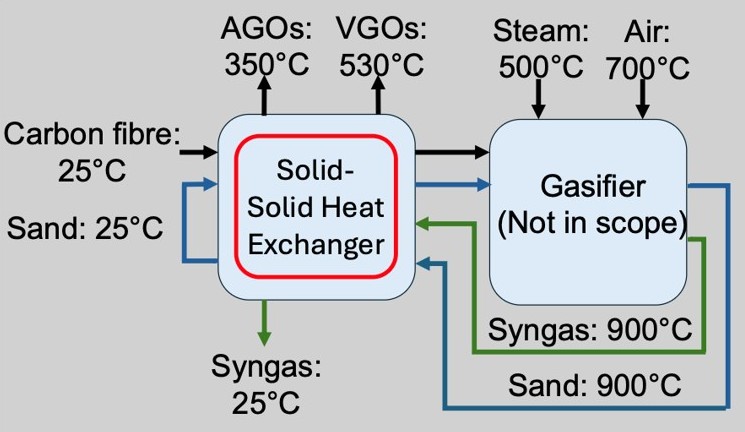
Originally designed for the oil sands of Canada, the NUWORP process recycles carbon based fuels by extracting useful gases by heating the fuels up to high temperatures. The reason it is viable as a recycling process is because the chemical reaction of the breakdown of the carbon based fuel into the useful gases is exothermic. This means that using a solid-solid heat exchanger to heat up the incoming fuels from the hot output material makes the process viable, economically and environmentally.
Wind turbine blades are difficult to recycle because of their composite construction. The proposed process involved shredding the blade material, mixing it with sand (for efficient heat transfer), and moving this mixture through the NUWORP process. Our task was to develop the heat-exchanger system, with particular attention to energy efficiency, maintainability and how the material would actually move through the system. We also had to take into account the behaviour of carbon fibre under heating.
Heat transfer modelling in MATLAB
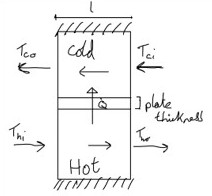
One part of the project I was particularly proud of was writing my own MATLAB model for a simplified counterflow heat exchanger. I divided the exchanger into sections and used heat-transfer calculations to estimate how the hot and cold streams would change temperature as they moved in opposite directions over time, until they would come to equilibrium. The model accounted for the average temperature difference across the separating plate and how much conduction would occur over each time step. This showed the energy movement through the simplified system, and taking the temperature input/output from each section the next time step energy movement could be worked out. This worked because I knew the constant input temperatures from each side of the overall counterflow system. I produced graphs showing the predicted temperature distributions.
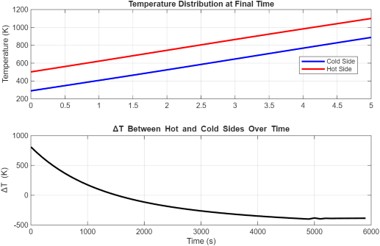
We compared my MATLAB results with the team's ANSYS simulations and found they were very close, which gave us more confidence in the modelling. I enjoyed building something from the underlying heat-transfer principles rather than relying entirely on simulation software.
Carbon-fibre experiments
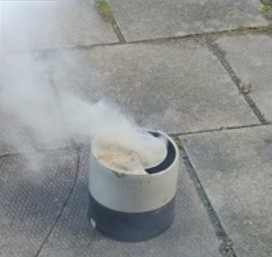
I carried out experiments to investigate what happened to carbon fibre when heated, particularly how its mass changed and its characteristics. Under the conditions tested, the samples lost approximately 40% of their mass and became loose fibres - not a sticky mess. This helped inform the assumptions we were making about the material as it passed through the proposed recycling system.
Designing the vibratory conveyor prototype
One of my main individual responsibilities was designing and making a working vibratory conveyor. We were considering vibration as a way of moving sand through the heat exchanger, with the additional possibility that mixing the particles could improve heat transfer. I also contributed ideas to the team's wider design, particularly how sand could be moved into and out of different parts of the system.
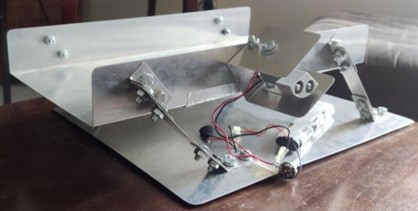
I made the prototype mainly from thin aluminium sheet and simple electronics. It needed to be portable and fit on a table for our final presentation, so I used an 8 × 12 inch base with raised sides. I worked in the university workshops, using a sheet-metal shear, punch, brake, belt sander and soldering iron to make and assemble the components.
Getting the bed to vibrate in the right direction
One of the first problems was supporting the moving bed. Ordinary springs were awkward to attach, and I needed it to move easily in a particular direction rather than in every direction. I came up with the idea of using thin aluminium strips bent to the required angle. They acted as flexible supports, and I could adjust their stiffness simply by adding or removing strips.
I had initially considered two counter-rotating motors to control the direction of the vibration, but testing showed that the aluminium-strip supports constrained the motion well enough for one motor to do the job. This made the design much simpler.
Making the vibration adjustable
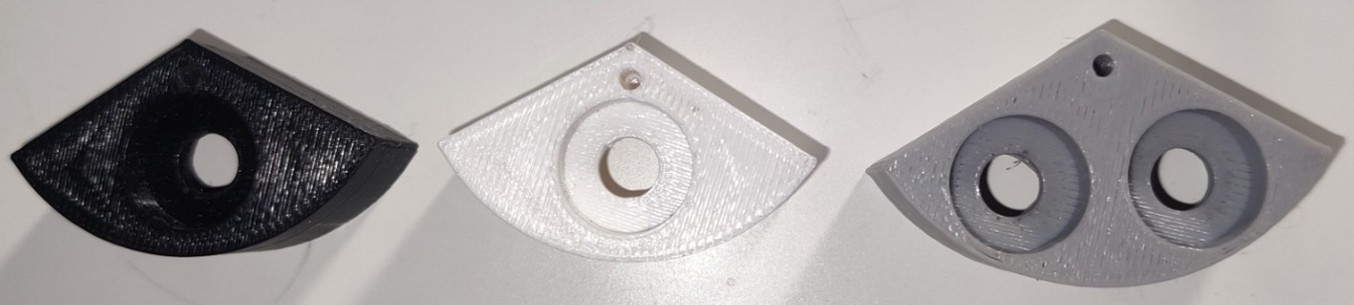
I used a small electric motor with an offset mass to produce the vibration. The difficult part was working out how much unbalanced mass was needed, because too little wouldn't move the sand and too much made it difficult for the motor to run properly. I designed and 3D printed several versions of the mass in SolidWorks, preparing the prints using Bambu Studio. It took a few attempts to get a suitable fit onto the motor shaft.
The final design had holes for bolts and nuts to sit in, so I could change the mass easily. I also used a variable resistor in the circuit to adjust the motor speed to find the resonance of the system, for the most efficient power input. I really enjoyed this part of the project, as each iteration made it clearer what needed changing next.
Testing and what we learned
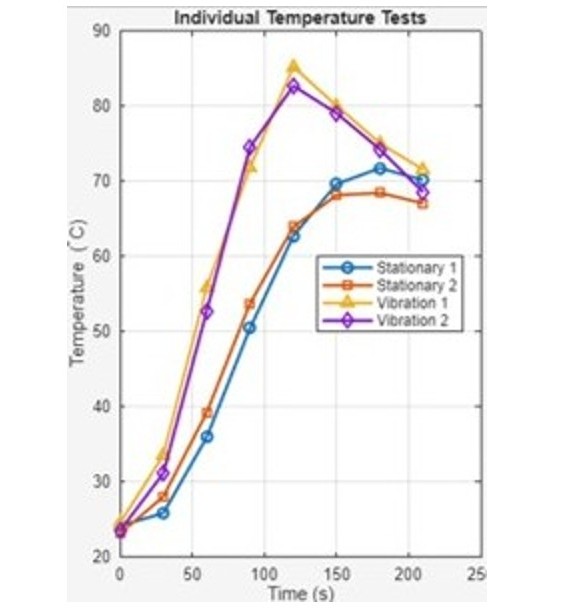
The finished prototype successfully transported sand. A teammate then used it for heat-transfer experiments, comparing sand heated while stationary with sand heated under vibration. The sand heated approximately 50% faster during the initial heating period with vibration, although both cases approached similar temperatures after longer periods. It was satisfying to see that a prototype I'd made could help test an idea properly.
However, the experiments also showed an important limitation. While the prototype could move a small amount of sand, moving much larger quantities at the very low speed needed for the full-scale exchanger would be difficult without excessive vibration and power input. We compared vibratory, en-masse chain and belt conveyor concepts, and eventually selected a belt conveyor for the final design because it offered lower friction and better energy efficiency.
Our final proposed system was a modular, belt-based heat exchanger. The team's calculations estimated about 44 W of mechanical power, equivalent to 0.18% of the calculated heat-transfer rate, this was below our 1% design limit. Further work to validate the design, look into material handling and long term durability is needed for future progress.
Project outcome
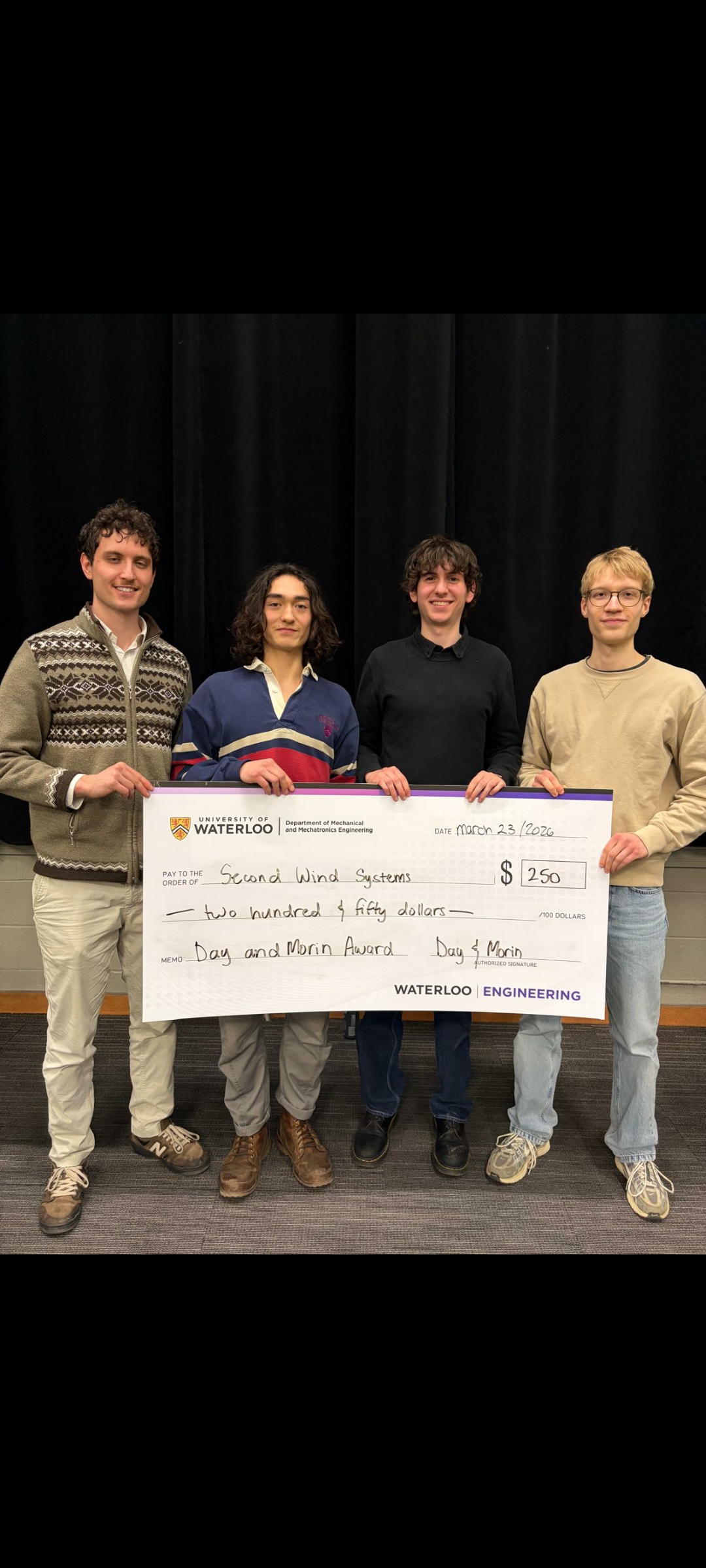
We worked well as a team, with frequent meetings and plenty of discussion as the design changed. Our project received the Day and Morin Sustainability Award at Waterloo's Capstone presentation evening.
I enjoyed how many different parts of engineering came together: concept generation, calculations, programming, experiments, manufacturing and learning when an idea needed to change.
University of Waterloo Baja Team
Joining the team
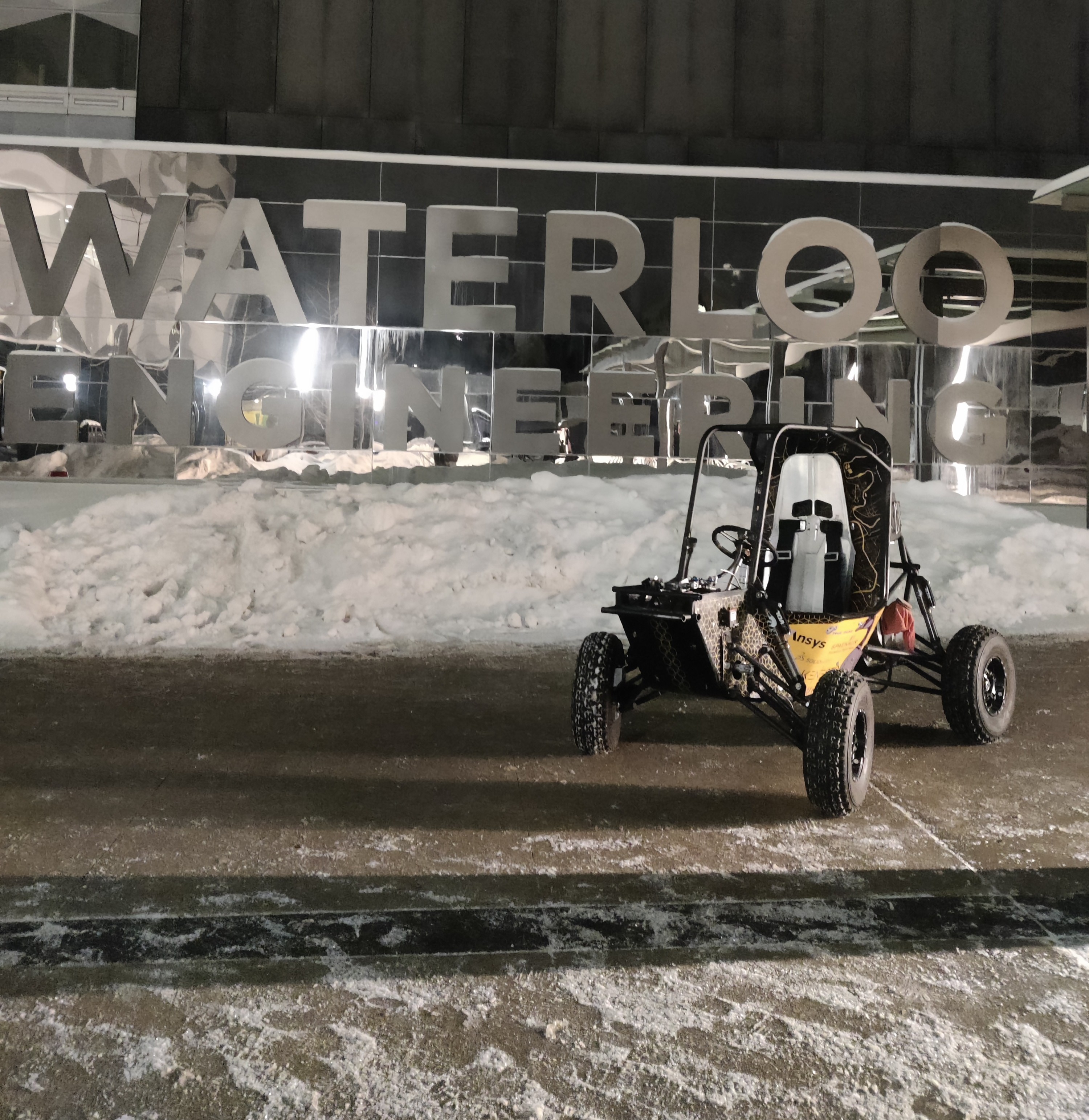
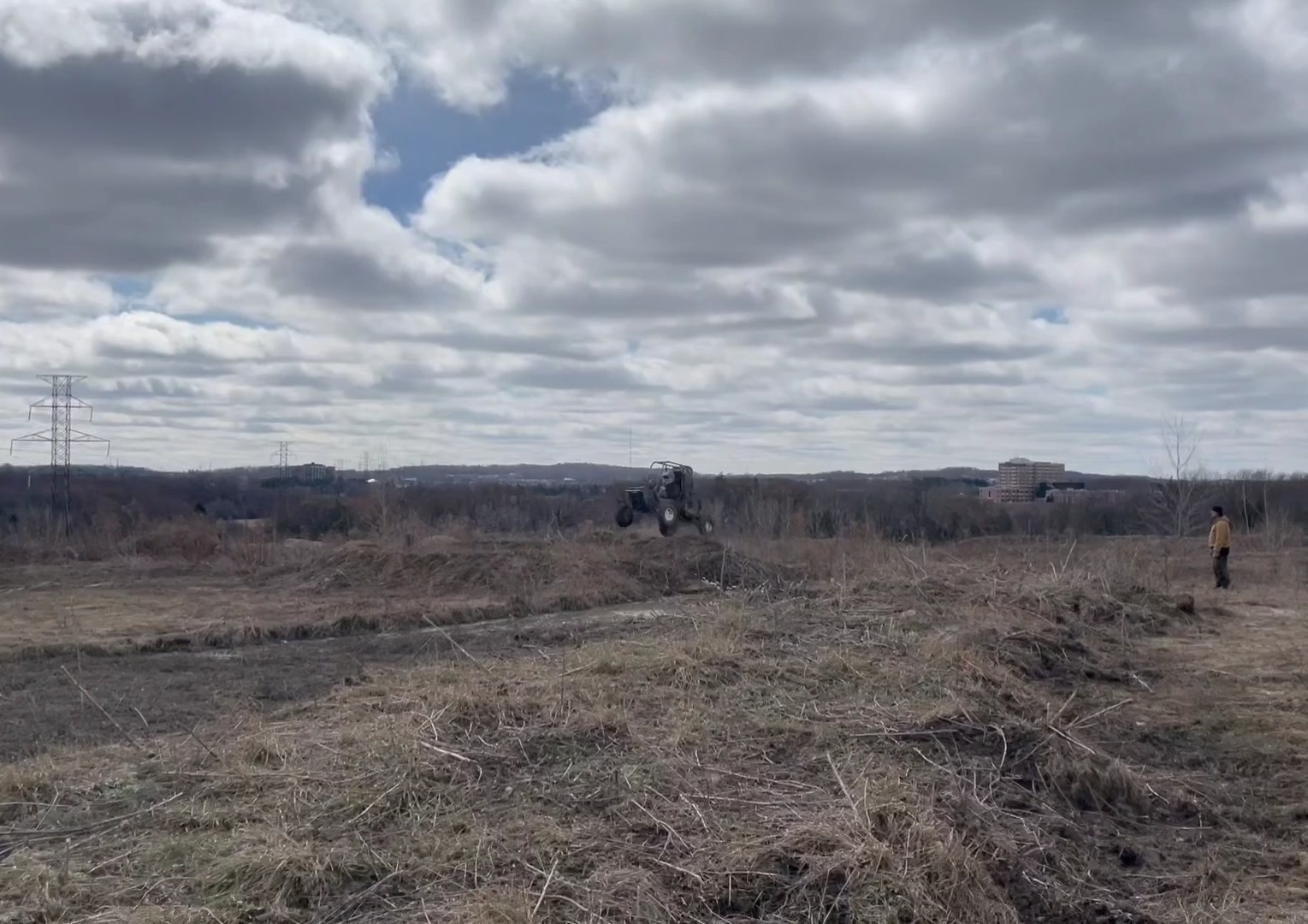
One of my favourite experiences during my year abroad in Canada was joining the Baja team. It's a student-run team that designs, builds, tests and races a single-seat off-road vehicle powered by a 10 hp petrol engine. The car has to be tough enough to survive rough terrain while still being reasonably light and efficient, which is exactly the sort of practical engineering I enjoy.
I met lots of new people, spent countless hours in the workshop, learned to use equipment I hadn't worked with before and had the chance to travel to Laval, Quebec, for a competition. It was a great way to get involved in engineering outside lectures.
Powertrain team
I joined the powertrain team, where the aim was to get reliable and efficient power to the wheels. With only 10 hp available, losses matter. One of the most interesting things for me was learning about the continuously variable transmission (CVT), which allowed us to use a fixed gearbox without a conventional manually operated clutch. I thought it was a very elegant mechanical solution.
I contributed initial ideas for active CVT cooling, helped with the chain-tensioning system and took part in discussions about dynamometer testing. I also helped prepare and repair the car, and got the opportunity to drive it.
Making the pedal foot plates
One job I took on myself was designing and making the pedal plates that the driver's feet press against. I looked at photos of rally-car pedals for inspiration, measured the mounting-hole positions and worked out a suitable size. Because the shape was simple and the tolerances were fairly generous, I decided it made more sense to go straight to manufacturing than to spend time making a CAD model or sketch.
I made the plates from thin aluminium sheet. I punched holes for slightly raised edges to give more grip, used a sheet-metal brake to bend up the sides to help keep the driver's feet in place, and smoothed the edges with a disc sander. It was a relatively small and simple component, but good experience in making something properly for its intended purpose.
The Laval competition
We travelled to Laval University in Quebec for two days of racing. The night before we were due to leave, I stayed in the workshop until about 5 am helping finish the bodywork and meet some of the more particular competition requirements. After a couple of hours' sleep, I returned ready for the long drive, only to find out that the buggy had been crashed during testing and the control arms on one of the front wheels were bent.
At that point it looked like we might not even make it to the competition. However, everyone stayed calm and worked through what could be replaced or repaired. We straightened as much of the damaged control arm as possible, fitted a thicker metal sleeve over it and welded it into place. The repair survived the weekend, and we managed to leave only a few hours later than planned.
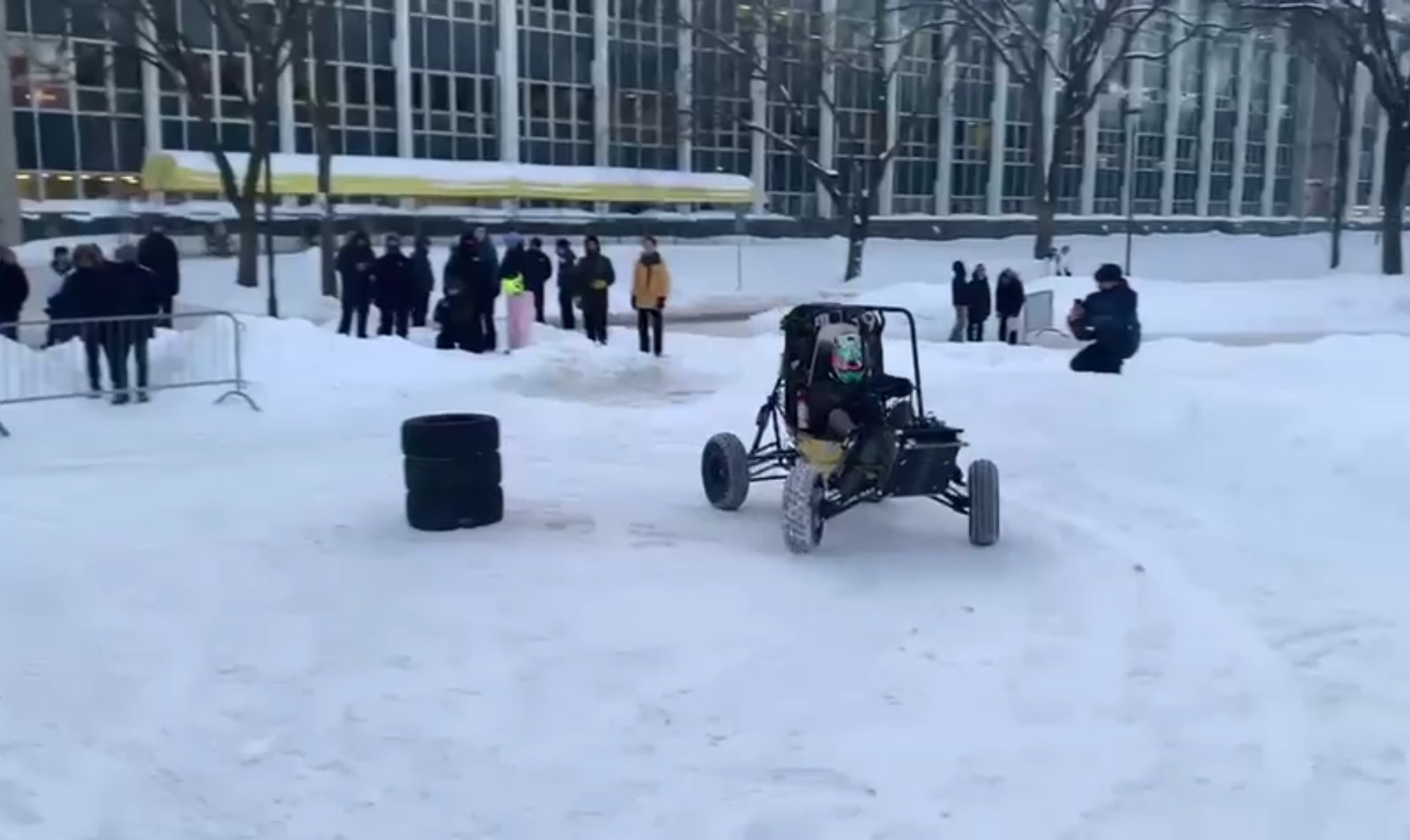
There were more time-sensitive repairs to make during the competition, including problems with an over-revving engine and a shattered sprocket. I found I actually enjoyed the pressure and the 'just get it working' side of things. I also got to race in the manoeuvrability test, which was challenging with a wobbly steering wheel and not much grip on the ice.
I'm very grateful to my Canadian teammates for including me in it all. The competition was a brilliant experience, and the journey also gave us a chance to explore Quebec City and stop in Montreal on the way back.
BIMTek — Engineering Internship
Working in an engineering consultancy
In the summer of 2025, I worked at BIMTek, an engineering consultancy in Somerset, involved in designing and upgrading wastewater treatment plants. It was my first proper experience of working in an engineering office and gave me a much better understanding of how different parts of a project come together.
I used Revit, Plant 3D and AutoCAD for engineering design and site information. I was also introduced to laser scanning, which the company used to record the geometry of existing plants and create CAD models for designing modifications. One of my design tasks was working on an adjustable weir and flume for an upcoming construction project.
Automating data transfer with Dynamo
The company had wanted to investigate automating the transfer of technical and schedule data between Revit and Plant 3D to save time. I was given the task, which was a good opportunity to work through a problem that didn't already have a set solution.
Using Dynamo, I developed a process which automatically exported information from Revit to an intermediate Excel file and then imported it into Plant 3D. I worked through it myself, with help from more experienced colleagues whenever I got stuck as dynamo was a new programming software to me.
I got the transfer working just as my internship finished. Looking back, the code could have been more efficient and the way of running it could have been simpler. Even so, I was pleased to get a working solution, and it taught me that making something function is one challenge, while making it easy for other people to use is another.
Sheffield Ecoboats — Power Management
Sheffield Ecoboats was a new student project, so there wasn't much previous work to build on. That was both a positive and a negative: we had a clean slate, but it also meant doing a lot of research before we could make decisions. I joined the power-management team because I wanted to try something beyond the mechanical topics I was studying on my degree.
We were trying to bring together the components needed to power the boat on a fairly tight budget. I investigated solar-panel options, comparing factors such as weight, size, power and cost, and looked at how to waterproof the power-management components. We settled on a waterproof enclosure with sealed wiring connections as a relatively simple and inexpensive solution.
It was a good introduction to working on an electrical system where I had quite a lot to learn, and to balancing technical requirements against practical constraints like cost and ease of manufacture.
Earlier Experience and Personal Projects
GeoSmart — Work Experience
I spent some time at GeoSmart, an environmental consultancy working on flood risk, drainage and sustainable development based in Shropshire. While there, I was introduced to geographic information systems (GIS) and spatial analysis. It was an early opportunity to see how engineering and environmental information are used in practice.
Electric Guitar
During college, I decided to make my own electric guitar. I'd been playing for a couple of years and wanted a nice-sounding guitar without spending too much. Buying a decent pickup and the electronics seemed more affordable, and I thought I could manage the woodworking and soldering myself.
I made the body from a block of ash wood, routing out the shape and the spaces for the wiring and pickup. I then took the neck from my brother's old guitar and attached it to the body I'd made. It was a satisfying project, and the guitar is still in use today and sounds lovely.
Portable Skateboard Quarter Pipe
During lockdown, I got more into skateboarding and wanted a portable quarter pipe to practise on. After seeing similar projects online, I worked out a design and produced drawings using skills I'd learned through my Engineering BTEC. I bought the materials and built it from wood.
It was one of my first chances to use engineering drawings and practical workshop skills on a project I'd come up with myself, rather than something set as coursework. I also came across the problem of having the wood too thick to bend onto the face on the ramp, so instead I used 2 thinner pieces for enough strength whilst still being able to secure it on without snapping.